Manipulation matrix: Difference between revisions
Create Manipulation Matrix article (Nir Eyal framework) with quadrant infographic |
Embed matrix diagram at native size (server thumbnailing unavailable); add caption |
||
| Line 3: | Line 3: | ||
The '''Manipulation Matrix''' is a decision framework proposed by [[Nir Eyal]] in his 2014 book ''[[Hooked (book)|Hooked: How to Build Habit-Forming Products]]''. It gives the maker of a habit-forming product a simple ethical test, plotting two questions against each other to reveal what kind of maker they actually are. | The '''Manipulation Matrix''' is a decision framework proposed by [[Nir Eyal]] in his 2014 book ''[[Hooked (book)|Hooked: How to Build Habit-Forming Products]]''. It gives the maker of a habit-forming product a simple ethical test, plotting two questions against each other to reveal what kind of maker they actually are. | ||
[[File:Manipulation-matrix.png| | <div style="float:right; margin:0 0 1em 1em; max-width:660px;"> | ||
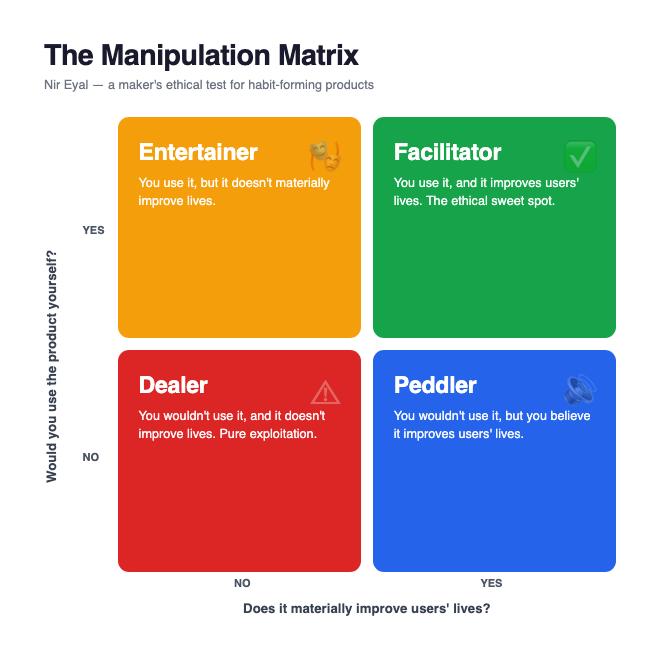
[[File:Manipulation-matrix-diagram.png|660px|link=|The Manipulation Matrix: two axes — "Would you use the product yourself?" and "Does it materially improve users' lives?" — producing four quadrants.]] | |||
<div style="font-size:90%; color:#555; text-align:center;">The Manipulation Matrix — the maker's two questions produce four quadrants.</div> | |||
</div> | |||
== The two questions == | == The two questions == | ||
Latest revision as of 2026-07-19T13:40:26
The Manipulation Matrix is a decision framework proposed by Nir Eyal in his 2014 book Hooked: How to Build Habit-Forming Products. It gives the maker of a habit-forming product a simple ethical test, plotting two questions against each other to reveal what kind of maker they actually are.
The two questions
The matrix is built from two yes/no questions the maker asks about their own product:
- "Would I use the product myself?" — Is this something the maker genuinely wants in their own life?
- "Does the product materially improve users' lives?" — Setting aside engagement metrics, does using it actually leave people better off?
Crossing these two axes produces four quadrants. Eyal's point is that the same persuasive techniques — the ones that make a product habit-forming — are ethically fine in one quadrant and predatory in another. The technique is neutral; the intent and the outcome are not.
The four quadrants
| Quadrant | Uses it? | Improves lives? | Meaning |
|---|---|---|---|
| Facilitator | Yes | Yes | The maker uses the product and it improves lives. Eyal argues this is where you have the best chance of building something both successful and healthy — you have empathy for the user because you are the user. This is the quadrant to aim for. |
| Peddler | No | Yes (believes so) | The maker thinks the product improves users' lives but wouldn't use it themselves. This gap often signals a lack of the empathy needed to build something people genuinely want, and it invites self-deception about whether the product really helps. |
| Entertainer | Yes | No | The maker uses it and enjoys it, but it doesn't materially improve lives — it just entertains. This isn't inherently wrong (entertainment has value), but entertainment is fickle, and building a lasting business here is hard. |
| Dealer | No | No | The maker neither uses the product nor believes it helps anyone — they're hooking people purely to extract value. Eyal calls this the position with "the least justification," morally indistinguishable from a drug dealer. There is no ethical cover here. |
Why it matters
The habit-forming techniques in Hooked — triggers, variable rewards, investment loops — are powerful, and Eyal was aware that they could be used to exploit people as easily as to help them. The Manipulation Matrix is his attempt to give makers (and himself) an honest gut-check before shipping:
- If you're in the Facilitator quadrant, use the techniques freely — you're improving a life you understand from the inside.
- If you're a Peddler, be honest about why you won't use your own product, and be skeptical of your claim that it helps.
- If you're an Entertainer, accept that you're in the business of enjoyment, not improvement, and don't kid yourself that it's more.
- If you're a Dealer, stop. There is no version of this that is defensible.
The framework's lasting value is that it reframes "manipulation" from a technique question into an intent-and-outcome question. The buttons you press are the same in every quadrant — what changes is whether you'd be comfortable being on the receiving end.
See also
- Nir Eyal
- Hooked: How to Build Habit-Forming Products
- Nir Eyal, "The Morality of Manipulation" — the essay version of the matrix on his blog, NirandFar.com